Voices of the Past. Origins

About the Book

◆ ◇ ◆

Journey to the Origins of Knowledge

Voices of the Past. Origins is a historical adventure about five modern schoolchildren who unexpectedly find themselves in Ancient Greece — in an age when people were beginning to ask questions that would change the course of history.

Five modern children suddenly enter the world of philosophers, astronomers, and geometers. To return home, they must collect the missing fragments of the Book of Forms — an ancient repository of knowledge scattered across cities and eras.

The Book itself is kept in secret in the Library of Alexandria, but it remains “asleep” until the missing pages are gathered and its meaning can be restored.

Along the way, the children meet some of antiquity’s greatest minds — Thales, Pythagoras, Euclid, Archytas, Eratosthenes, Heron, Hypatia, and others whose ideas survived for millennia.

Their path leads through Miletus, Croton, Athens, Alexandria, and Syracuse. The journey is far more dangerous than they expected. The Order of Shadow is hunting the fragments, convinced that knowledge itself is a threat, and the children must discover what truth can sometimes cost.

Voices of the Past. Origins is a novel about friendship, courage, and curiosity — about why questions can matter more than ready-made answers, and why voices from the past continue to speak in the present.

The book is also intended for adult readers who enjoy ancient cities and libraries, and clear explanations of ideas that changed the development of mathematics.

The historical events and scientific discoveries in the novel are based on real facts. Time travel is the story’s one fictional assumption, allowing scholars from different eras to meet within a single narrative.

Before the Journey Begins

Dear Friend!

◆ ◇ ◆

You are holding an unusual book — a journey through time, mystery, and remarkable discoveries.

Five ordinary schoolchildren suddenly find themselves far in the past. To return home, they must collect the missing fragments of the mysterious Book of Forms. Their path will cross great scholars, ancient cities, dangerous secrets, and questions humanity has pondered for centuries.

You do not need to know mathematics or history in advance. You need only one thing: the courage to ask questions. Sometimes a discovery begins with a simple “why?”

We hope this journey gives you not only an adventure, but also a desire to see familiar things in a new way.

A Note from the Authors

Parents & Teachers

◆ ◇ ◆

This book was created as a story through which children can encounter knowledge, people, and discoveries in a vivid and honest way — without turning reading into a lesson.

“Our goal is not to provide ready-made answers, but to awaken curiosity and show that the path to knowledge can be living, human, and engaging.”
The Contents as a Route

Journey Through the Chapters

◆ ◇ ◆

The chapter titles trace a route through the ancient world. Select a chapter to read a short spoiler-free preview.

Modern Travelers

Heroes

◆ ◇ ◆

Five children enter the past together, but each experiences the journey differently. Timon helps them navigate the ancient world.

Emmett

Emmett

14 years old. The oldest of the children. Responsible and cautious, he tries to protect the others even when he is unsure which choice is right.

Elliott

Elliott

12 years old. Brave, quick to decide, and ready to go first. Sometimes his determination helps the group; sometimes it creates new trouble.

Anna

Anna

11 years old. Serious, observant, and curious. She pays special attention to the sky, maps, and anything that helps explain how the world works.

Evie

Evie

9 years old. Attentive to detail, she loves sketching and writing down what she sees. She often notices what everyone else misses.

Vicky

Vicky

7 years old. The youngest, spontaneous and fearless in her honesty. Her questions often matter more than the adults’ explanations.

Timon

Timon

About 20 years old. The children’s young guide in the ancient world. He helps them understand its customs, roads, and dangers, while learning from his visitors from the future.

Cities of the Ancient World

Journey

◆ ◇ ◆

This book is a journey through time.

Every journey has its places: Miletus and Croton, Athens and Alexandria, Syracuse and Tarentum — cities where ideas that changed the world were once born.

These are the settings of our story. The cities are like knots on a thread of time, connected by the path of the young travelers.

Choose a city beside the map to open its historical note.

The map places ancient names beside modern ones. Many modern geographical labels did not yet exist in the eras described, but we include them deliberately so young readers can more easily understand where the story takes place. This, too, is a kind of binding of times.

Map of the ancient world
Who’s Who

Scholars and Scientific Schools

◆ ◇ ◆

All the sages and scholars mentioned in this book are real historical figures. They truly lived and worked. Their ideas changed history. They stood near the origins of mathematics and left a brilliant mark on its development.

This page is organized not as a simple list of names, but as a story of developing thought: first the school, its ideas and atmosphere — then the people.

The Book of Forms

A future version of the site will include a special entrance to an interactive Book of Forms — a collection of the fragments found by the characters.

Continue Exploring

Beyond the Book

◆ ◇ ◆

This section will grow into a collection of materials about the real history behind the discoveries.

The Library of Alexandria

The history of the great repository of knowledge and what is known about its fate.

The Impossible Problems of Antiquity

Doubling the cube, trisecting the angle, and squaring the circle.

Eratosthenes’ Method

How to measure the Earth using a shadow, a distance, and reasoning.

Euclid’s Manuscripts

How ancient texts traveled through languages and centuries.

Archimedes and His Method

A story of discoveries, legends, and lost manuscripts.

Section in development

New articles, illustrations, and historical materials will gradually appear here.

Knowledge as Adventure

Explore & Play

◆ ◇ ◆

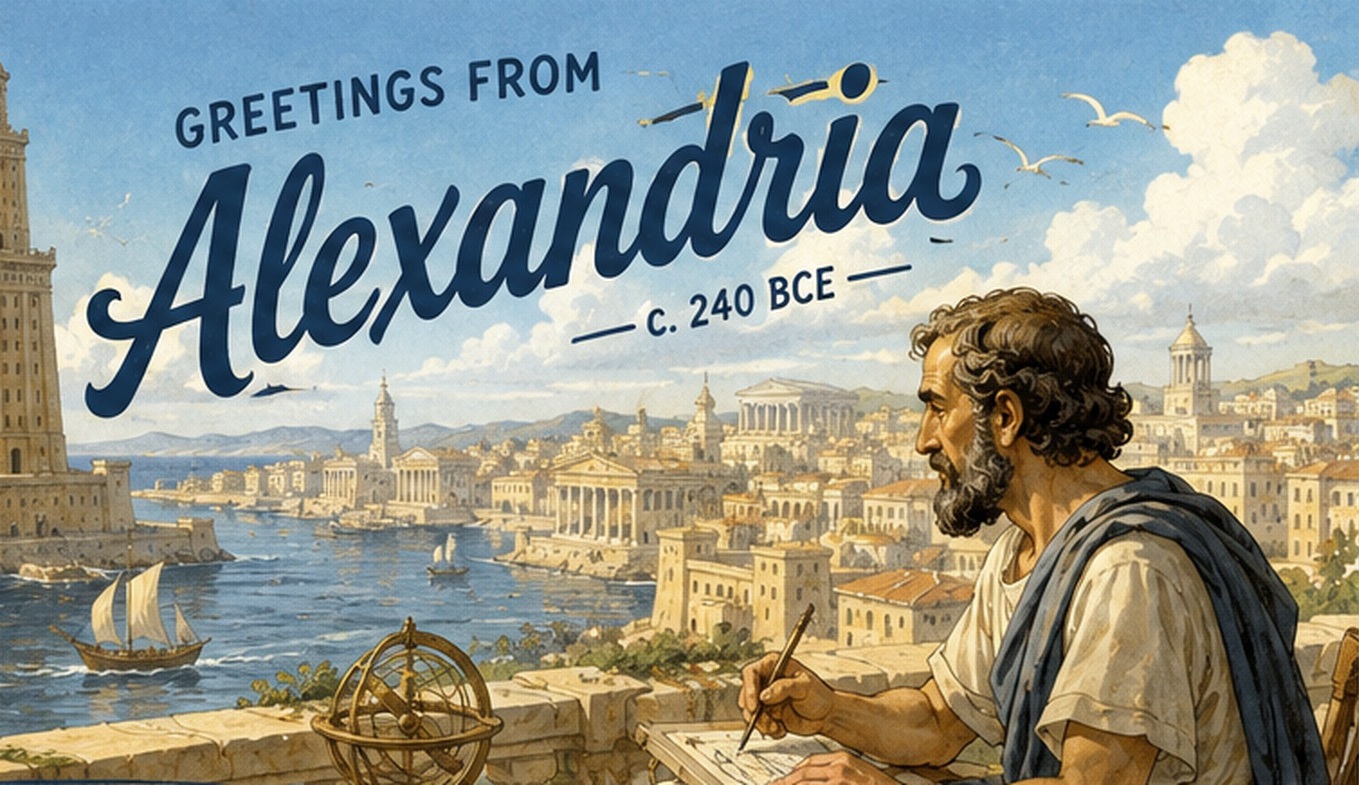
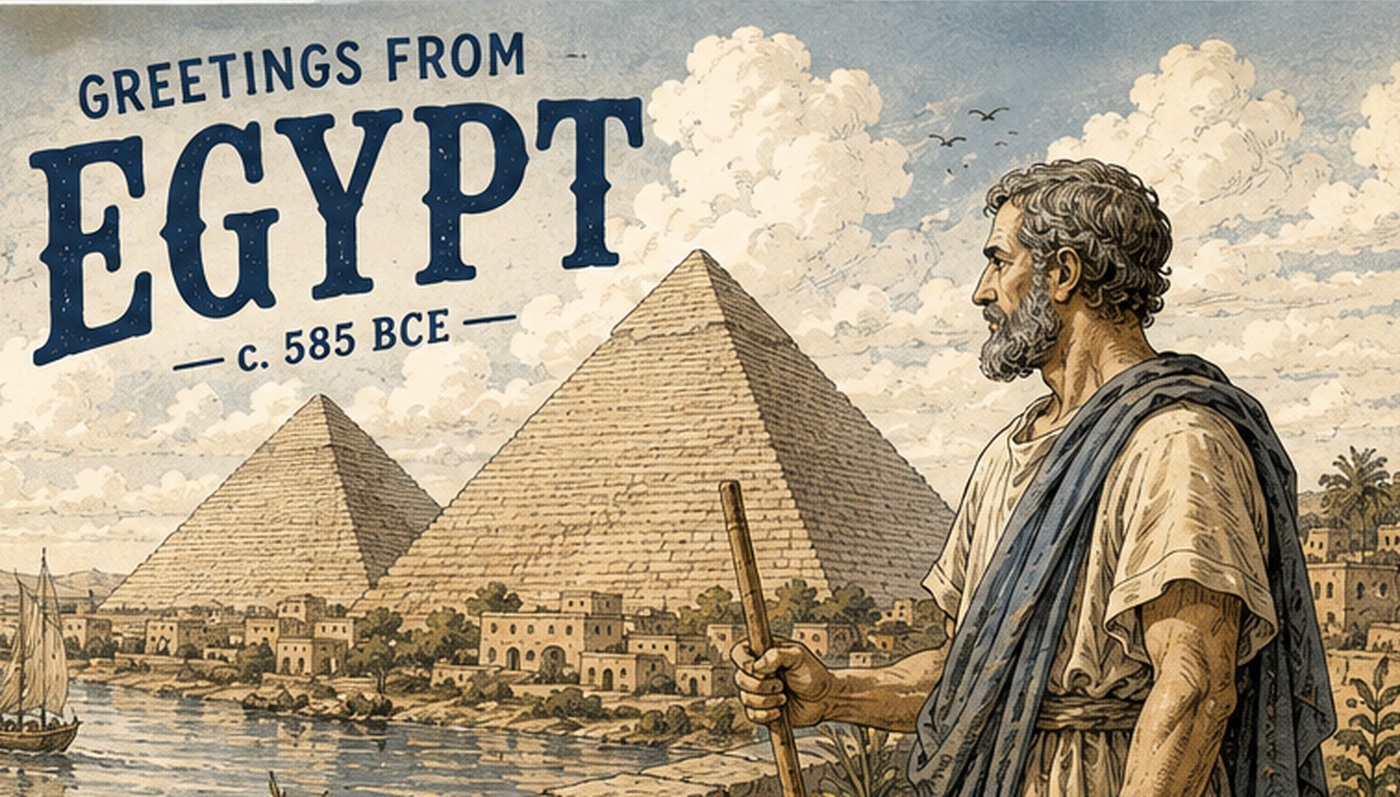
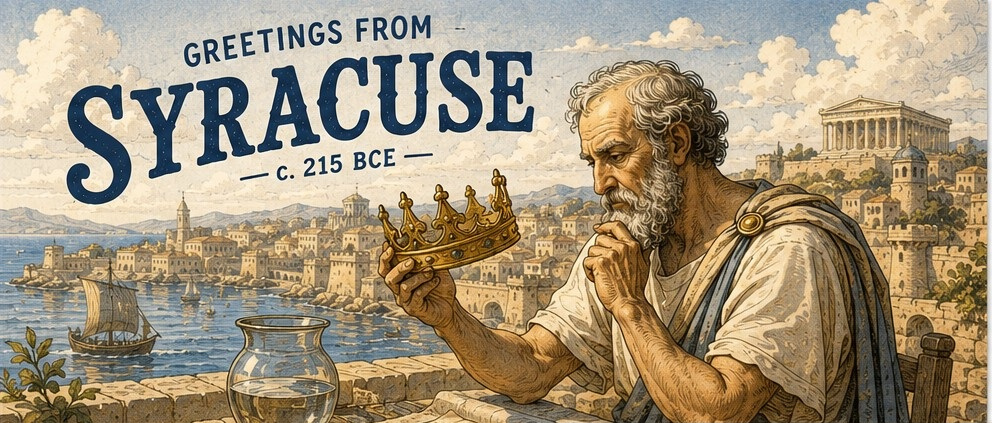
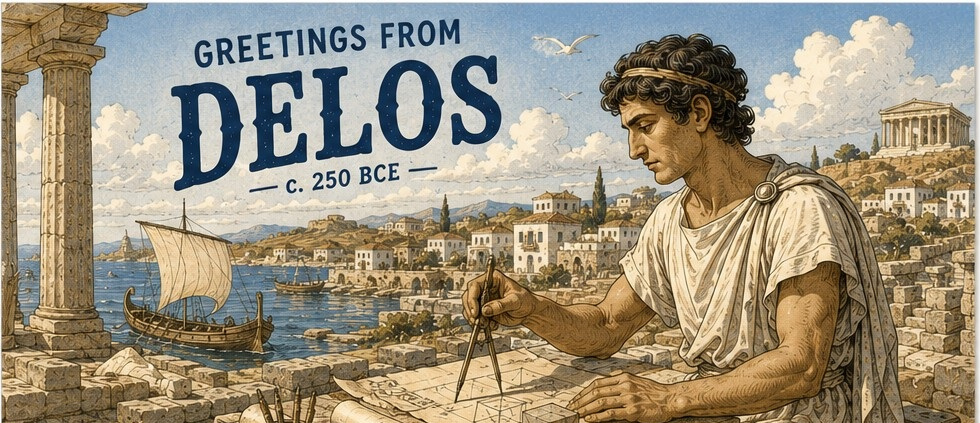
Postcards from the Past turn questions from the ancient world into small adventures. Pick a postcard, take the challenge, and discover how thinkers more than two thousand years ago approached problems that still fascinate us today.

Keep Exploring

More Games & Activities

Assemble a Fragment

A puzzle inspired by the Book of Forms.

Build a Proof

Geometric problems and classical Greek constructions.

Decode a Papyrus

Activities inspired by ancient manuscripts.

Archimedes’ Inventions

Mechanical puzzles and simple experiments.

More activities are in development

New games, experiments, and printable activities will be added gradually.

Educational Materials

For Teachers

◆ ◇ ◆

Worksheets

Activities connected to the chapters.

Chapter Questions

Discussion prompts for classrooms or book clubs.

STEM Projects

Hands-on projects inspired by ancient discoveries.

Presentations

Ready-to-use visual materials for lessons.

Teaching Resources

Ideas for using the book across subjects.

Section in development

Materials for teachers, parents, and group leaders will be added gradually.

About the Authors

Authors

◆ ◇ ◆

Igor A. Karnovsky, D.Sc.

Professor and specialist in applied mathematics, structural mechanics, and engineering, with more than fifty years of professional experience. Author and co-author of numerous scientific books published by Springer and McGraw-Hill.

Voices of the Past. Origins is his first work of fiction, bringing the history of mathematics and science to life through a journey across eras.

Olga Lebed, M.Eng., M.Sc.

Engineer, mathematics educator, and programmer with more than twenty-five years of experience in engineering, education, and software development. She has taught mathematics and engineering in Canada and Ukraine and is co-author of several scientific and technical books published by Springer and McGraw-Hill.

Voices of the Past. Origins is her first work of fiction, born from a wish to make the history of mathematics and science vivid and engaging for young readers and their families.

Thank you, my dear friends, who helped with this website: Dave Anderson, Sergey Nartovich, Tamara Moldon.

Previous Publications

Selected Scientific Books

◆ ◇ ◆
  1. Karnovsky I., Lebed O. Advanced Methods of Structural Analysis: Strength, Stability, Vibration. Second Edition. Springer, 2021.
  2. Karnovsky I., Lebed E. 振动防护理论, Theory of Vibration Protection. Chinese Edition, 2019.
  3. Karnovsky I., Lebed E. Theory of Vibration Protection. Springer, 2016.
  4. Karnovsky I. Theory of Arched Structures: Strength, Stability, Vibration. Springer, 2012.
  5. Karnovsky I., Lebed O. Advanced Methods of Structural Analysis. Springer, 2009.
  6. Karnovsky I., Lebed O. Free Vibration of Beams and Frames: Eigenvalues and Eigenfunctions. McGraw-Hill, 2004.
  7. Karnovsky I., Lebed O. Non-Classical Vibrations of Arches and Beams. McGraw-Hill, 2004.
  8. Karnovsky I., Lebed O. Formulas for Structural Dynamics. McGraw-Hill, 2001.
  9. Karnovsky I.A., Pochtman Ju. M. Methods for Optimal Control of Vibrations of Deformable Systems. Vyshha Shkola, 1986.
Begin the Journey

Buy the Book

◆ ◇ ◆
Cover of Voices of the Past. Origins

Available Editions

Choose an edition and continue to Amazon.com to order.

Edition Language Format ISBN Amazon.com
Voices of the Past. Origins English Paperback 978-1-0673517-2-4 View
Голоса прошлого. Истоки Russian Paperback 978-1-0673517-0-0 View